Sights in Limeuil — 9 of Our Favourites

Discover and book the top Limeuil sights

Les Jardins Panoramiques, Limeuil

1. Les Jardins Panoramiques, Limeuil

This beautiful and vast area has been split into themed garden areas, with interpretive trails running through them to both educate and add to the enjoyment of visitors.

Planted in the late 19th century, the arboretum provides trees and plants of various origins and a newer collection of unusual shrubs. The choice of species evoke memories of Spanish-Moorish gardens. The medieval garden is a square garden overlooking the village of Limeuil is devoted to medieval plants: here you can discover their virtues and their uses. The water garden consists of two pools and two waterfalls overlooking the river confluence. Here you can find all plants related to the river and the aquatic world: rushes, arrowhead, water plantain, irises marshes and water lilies decorate the scene. 

Gouffre de Proumeyssac

2. Gouffre de Proumeyssac, Le Bugue

Location
Le Bugue

The largest cave in the Périgord region, close to the pretty and tranquil town of Le Bugue. Proumeyssac has a vast subterranean grotto reaching 40 metres in height.

Filled with impressive crystal formations, it has been spectacularly lit and visitors are treated to a light and sound show. It is possible to descend into the cave using the old-fashioned horse-drawn basket which was used before the tunnel entrance was created. Audio guides are available in several languages, including English, german, Spanish, Italian and Japanese.

Outside the cave there are also plenty of children's activities, such as a playpark, picnic areas, water features and animal park.

Grotte Bara-Bahau, Le Bugue

3. Grotte Bara-Bahau, Le Bugue

Location
Le Bugue

The southernmost of all the caves of the Vézère valley, Bara-Bahau was classified as an historic monument in 1961.

The first part of the cavity has been accessible for some time, however, the deeper part of the cave containing the engravings and paintings, was discovered in April 1951 by the famous French caver, Norbert Casteret and his daughter Maud, who was the first to recognize the parietal engravings.

Guided tours are available in both English and French.

a church in a square of the village of cadouin dordogne

4. Abbaye de Cadouin Abbey, Le Buisson-de-Cadouin

Founded by Gérard de Salles in 1115, and affiliated to the Cistercians, the Cadouin Abbey is an incredibly well-preserved example of religious architecture.

Its church is built in a Romanesque style and it has an impressive sculpted Gothic cloister. It is listed amongst the UNESCO World Heritage sites on the pilgrimage route to Santiago de Compostela. It really dominates this small village and is worth a visit for those with an interest in architecture, history and photography.

rock formation within a cave at cadouin

5. Grottes de Maxange, Le Buisson-de-Cadouin

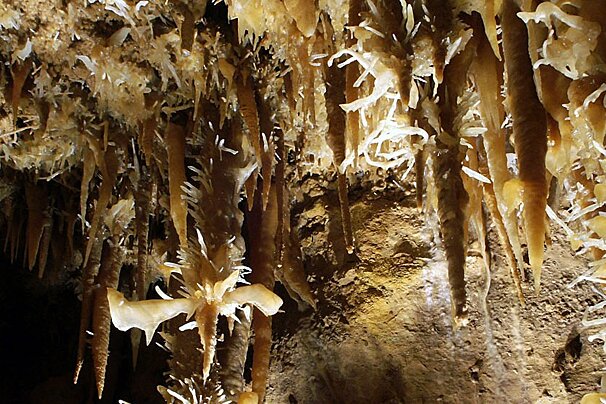
These caves were discovered in 2000 by quarrying work and contain a unique concentration of calcite formations.

A number of caves have been cleared and have some of the most beautiful and eccentric crystal concretions. These structures require a very specific combination of porous limestone, a water flow over the walls and a precise microclimate to form.

Easily accessible, these caves are definitely worth a visit.

Les Bambous de Planbuisson, Le Buisson de Cadouin

6. Les Bambous de Planbuisson, Le Buisson de Cadouin

With nearly 200 species of bamboo and 210 other grasses from around the world as well as rare trees and shrubs, perennials, annuals, herbs and wild, this is a truely wonderful collection.

Noted as being one of the finest collections of bamboo and other grasses in Europe, this botanical garden covers an area of 1.5 hectares. Originally designed as a botanical conservatory in 1989, the garden was gradually organised into landscaped areas. It now offers visitors the chance to walk around for about one hour in a tropical and exotic setting of lush vegetation.

Chapelle Saint-Martin, Limeuil

7. Chapelle Saint-Martin, Limeuil

Location
Le Bugue

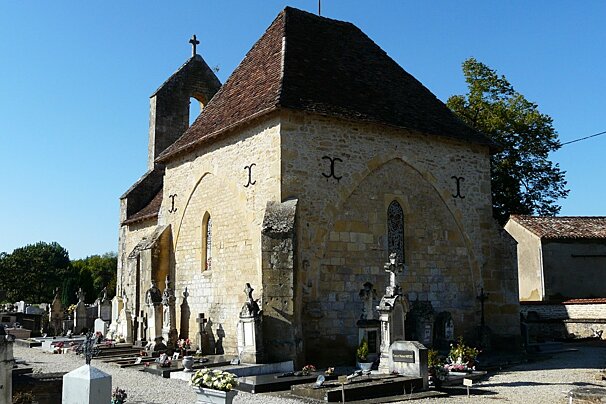
The church at Saint-Martin is distinguished for its original frescoes, which can be foudn inside, and its dedication stone.

The church is actually dedicated to Thomas Becket. The story goes that Becket was trying to arrange a marriage between Henri le Jeune (heir to the English throne) and Marguerite (eldest daughter of the King of France). When Henri died, the marriage of course did not happen, and so Becket lost favour with both kings. He was murdered by four knights loyal to the English king and it is now said that as atonement for their parts in the murder, the Kings of England and France jointly had three churches built and dedicated to Thomas Becket. One of these is the Chapelle Saint Martin.

courtyard outside church saint nicolas in tremolat

8. Eglise Saint Nicolas, Tremolat

Location
Tremolat

Trémolat's first church was built in the 9th century and now today all that remains of the original work are two arches, north and south of the nave at the intersection of the transept. 

It was only between 1125 and 1160 that the present church was built. The original cloister from this time has now disappeared but other traces can still be seen today. This monastic church was dedicated to Mary, Mother of God, but became the local parish church after the revolution, when it took on the name of Saint Nicolas. Substantial restoration work which took place earlier this century between 2000 and 2010.

In it's current state the building and interior are quite splendid. You can admire the frescoes in particular from the XIV (14th) century and the two altars of the eighteenth century.

Eglise Saint Hilaire, Tremolat

9. Eglise Saint Hilaire, Tremolat

Location
Tremolat

This church in very bad condition after the war, and so it was lovingly restored in the 1950s by the locals of the town who were very attached to its heritage.

The construction of the church in Romanesque style dates back to the 12th century. The vault of the choir was rebuilt in the 15th century in Gothic style. The porch area was registered as an historical monument in 1955, and the church was eventually fully recorded as a momentum in 2010.