Sights in Les Eyzies-de-Tayac-Sireuil — 11 of Our Favourites

Discover and book the top Les Eyzies-de-Tayac-Sireuil sights

Grottes du Roc de Cazelle, Les Eyzies-de-Tayac

1. Grottes du Roc de Cazelle, Les Eyzies-de-Tayac

Location
Les Eyzies-de-Tayac-Sireuil

The walk through this park will take you past rock shelters, caves and dwellings where a great number of tools and weapons, dating back over 12,000, have been discovered.

The cliff face that is visible from the roadside has always been occupied and inhabited. First during the prehistoric times, then later on when it was used a fortification during the middle ages, and finally when it was transformed at the beginning of the 20th century and used as farm dwelling.

As well as the park itself, you can explore the cliff terraces and the marsh, plus taking a visit to the farm and workshops that have been entirely dug out of the rock.

Maison Forte de Reignac, Tursac

2. Maison Forte de Reignac, Tursac

Location
Les Eyzies-de-Tayac-Sireuil

This is an impressive honey-stoned troglodyte house built within large cave shelters. Its relatively modest exterior disguises the space within, which is decorated in a grand style, with original medieval furniture and tapestries. 

Its front was built in the 14th century but its windows were not put in until the 16th century. It served as a strong fortification against attack. It also houses a well-known exhibition on the history of torture, with examples of instruments.

Read our review of a trip to this unusual fort here.

painted bison in Grotte de Font-de-Gaume

3. Grotte de Font-de-Gaume, Les Eyzies-de-Tayac

Location
Les Eyzies-de-Tayac-Sireuil

The prehistoric paintings in the Font-de-Gaume caves near Les Eyzies-de-Tayac were discovered at the turn of the 20th century by Denis Peyrony. 

Second only to those found in the caves at Lascaux, they contain over 200 paintings dating back to approximately 15,000 BC. Most incredible is the freeze of five bison discovered by accident during cleaning. These are some of the best known examples of prehistoric art still open to the public. 

Musee National de la Prehistoire exterior

4. Musee National de la Prehistoire, Les-Eyzies-de-tayac

Location
Les Eyzies-de-Tayac-Sireuil

The remains of the Château de Tayac built into the side of the cliff, have been transformed into a museum in a modern style by Jean-Pierre Buffi. 

The National Museum of Prehistory holds an outstanding collection of artefacts dating from the Ice Age, which include paintings, carvings and replicas of ancient skeletons, and human prints. Its collection is one of the largest in the world, with a minute proportion of its total holdings being displayed at any one time.

Grotte du Grand Roc, Les Eyzies-de-Tayac

5. Grotte du Grand Roc, Les Eyzies-de-Tayac

Location
Les Eyzies-de-Tayac-Sireuil

The Grand Roc cave, registered with UNESCO as a World Heritage site, is a true mineral forest, including crystallizations, calcite flows, stalactites, stalagmites, pillars, eccentric stalactites, draperies, and more. 

Discovered in 1924 by Jean Maury, the caves were opened to the public in 1927. The cave was inhabited by our ancestors at various periods throughout prehistory, and in particular 15,000 years ago by Cro-Magnon. 

You can also visit the Abris of Laugerie-Basse where large amount of archaeological remains shows a cultural and artistic activity unrivalled in the area and even in Europe.

Grotte des Combarelles

6. Grotte des Combarelles, Les Eyzies-de-Tayac

Location
Les Eyzies-de-Tayac-Sireuil

This cave houses an impressive collection of prehistoric paintings and engravings dating from the Magdalenian period. Through its winding passageways, there are over 600 engravings of animals and stylised humans.

The cave has been well preserved and is lit in order to give you the best view of the engravings. This really brings the animals to life right in front of your eyes.

salmon engraving Abri du Poisson, Les Eyzies-de-Tayac

7. Abri du Poisson, Les Eyzies-de-Tayac

Location
Les Eyzies-de-Tayac-Sireuil

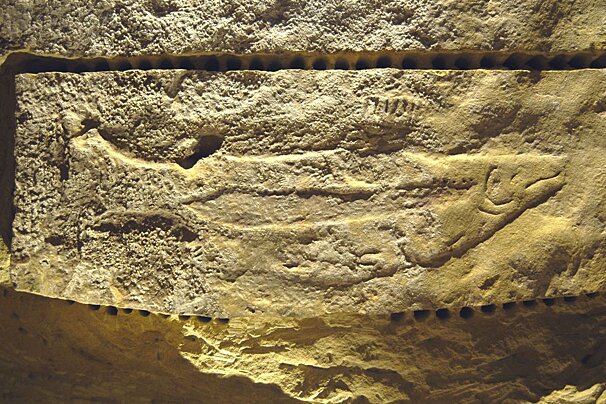
This rock shelter was discovered in the late 19th century, but its fascinating engravings of prehistoric fish were not identified for some 20 years. 

An important site, since engravings and painting of fish are incredibly rare in Stone Age art. It's most significant engraving is of a one metre long becquart salmon in the ceiling. The image has been there for some 25,000 years and is one of the oldest known fish carvings in the world.

L'Abri Cro-Magnon, Les Eyzies-de-Tayac

8. L'Abri Cro-Magnon, Les Eyzies-de-Tayac

Location
Les Eyzies-de-Tayac-Sireuil

Built on the location where the first burial site was discovered by modern man in 1868, the Museum of CRO-Magnon Shelter offers the public the chance to interact with our ancestors and to (re) discover our history.

Different reading levels offer more sophisticated content to the general public, including children, and visitors, allowing them to break free from the usual clichés about prehistoric men.

Tours are available in French and English. Hand outs are available in German, Dutch, Spanish, Italian.

Abri Pataud, Les Eyzies-de-Tayac

9. Abri Pataud, Les Eyzies-de-Tayac

Location
Les Eyzies-de-Tayac-Sireuil

The Pataud Shelter (or Arbi Aptaud) is one of the few prehistoric sites in the area which also shows how it has been dug and the archaeological techniques used.

Thanks to the different archaeological layers, visitors can easily view the chronology of civilizations that have been present in the cliffs of Eyzies. They also reveal the evolution of landscapes over millennia. 

The first inhabitants of the Pataud shelter dates from around 35,000 years ago; they were semi-nomadic hunter-gatherers. Around 28,000 years ago the Gravettians then settled here but for longer periods. The shelter was enlarged into the rock at this time. At the end of the Gravettian civilization (22,000 years ago), the roof collapsed and there remained only a narrow corridor along the rock wall. It was then used as a place of burial: the remains of 6 people have been found here.

International Centre of Prehistory (Pole International de la Prehistoire), Les Eyzies-de-Tayac

10. International Centre of Prehistory (Pole International de la Prehistoire), Les Eyzies-de-Tayac

Location
Les Eyzies-de-Tayac-Sireuil

Opened in July 2010, located near the National Museum of Prehistory, it aims to enhance and make accessible to all audiences the universal heritage of the Vézère valley, rich in many important prehistoric sites.

There are some great multi media exhibits, with good English translations, making this museum a worthwhile stop in gaining understanding of pre-history and evolution. There are plenty of interactive games and displays to keep the kids interested too and they run workshops at particular times of the year which are good for both adults nad children.

The space includes the display areas, shop, exhibitions, a 230 seat auditorium and an education and animation area.

a home built into the rock in village la madeleine

11. La Madeleine, Tursac

Location
Les Eyzies-de-Tayac-Sireuil

This village on the Vézère river has been inhabited since prehistoric times when cavemen dwelled in the rock shelters offered in the sides of the cliffs. 

Archaeologists have found jewellery and tools here from Roman times too. The troglodyte village you see today originates back to about the 10th century. Its fortifications were built around the 12th century, although there are limited remains of these left today. It has an intact part-troglodyte chapel dating from the 15th century and the remains of a number of houses. No longer inhabited, it was abandoned in the early 20th century.