Sights in Sarlat-la-Caneda — 5 of Our Favourites

Discover and book the top Sarlat-la-Caneda sights

Manoir de Gisson Museum, Sarlat-la-Caneda

1. Manoir de Gisson Museum, Sarlat-la-Caneda

Location
Sarlat-la-Caneda

With mullioned windows, dark grey stone slate roof (lauze) and the well-known honey-coloured stone of the facade, this is one of the most remarkable buildings in Sarlat.
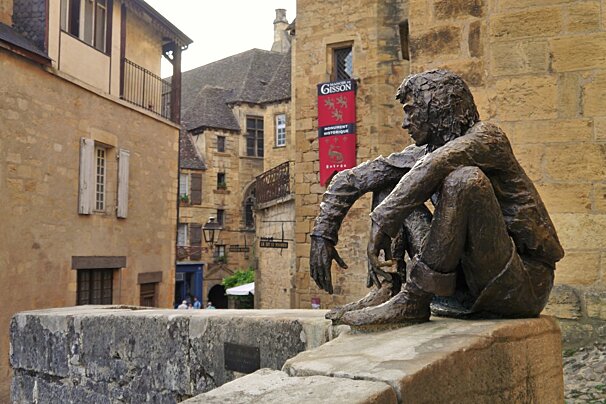
You can enjoy a tour of this house to experience life as it once was in the medieval town of Sarlat. Moving from room to room you will see original furniture and decoration that will give a real insight into the life of the upper classes of the Renaissance period.

All the explanation panels are in French but you can pick up a leaflet at the entrance that has English translations so that you can understand everything.

View along Rue de Montaigne

2. Lanterne des Morts (Lantern of the dead), Sarlat-la-Caneda

Location
Sarlat-la-Caneda

The Lanternes des Morts (Lanterns of the dead) are small towers mainly found in the central and western parts of France. Thought to indicate the position of a cemetary.

This is a particularly fine example and well-preserved building that dates back to the 12th-century. The origin and use of such lanterns are controversial. Some of those lanterns are said to be "lanterns of the Moors" instead of "lanterns of the Dead". The illiteracy of most of the population in the past can easily explain this as "the Moors" (les Maures) and "the dead" (les morts) sounds very similar.

Some of the lanterns in France do not indicate any cemetery and their architecture has strong oriental influences. The origin of the lantern in Sarlat is linked with the abbot Bernard of Clairvaux, who played a major role in the Second Crusade. It is said to have been built after a visit of the abbot in the city, in 1147, possibly by the Knights Templar.

A view of the indoor market hall in sarlat

3. Sarlat Panoramic Lift, Sarlat-la-Caneda

Location
Sarlat-la-Caneda

The glass lift with panoramic views, housed within the old Church Sainte-Marie’s bell tower offers a unique experience. Once at the top, the lift, whose walls are made entirely of glass, allows you a 360° view of Sarlat.

The church of Sainte Marie was built in 1385 and was transformed in 1905 into a post office. It was transformed once again in 1935 and served as a health center. Later abandoned, the municipality asked architect Jean Nouvel to renovate the building. In 2000, he created two giant steel doors which restore all the scale in the nave by restoring its volume and opening the triumphant arch which formerly overlooked the choir.

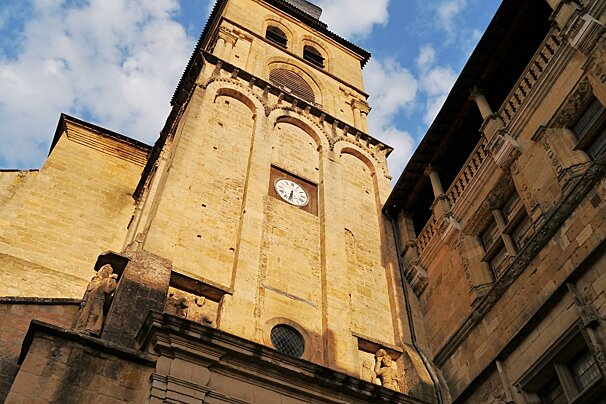
looking up to the clock & bell tower of Cathedrale Saint-Sacerdos

4. Cathedrale Saint-Sacerdos, Sarlat-la-Caneda

Location
Sarlat-la-Caneda

Taking some three and a half centuries to build, this small cathedral is the centre piece and heart of the community in Sarlat-la-Caneda.

When Sarlat became a diocese (district under the control of a Bishop) in 1317, the first bishop decided to transform the old abbey church into a cathedral worthy of the name. But the Hundred Years' War ended the architectural project. It was not until the early 16th-century that the Bishop Armand of Gontaud-Biron decided to resume the works. He commissioned the architect Pierre Esclache to complete the cathedral.

Work ceased again in 1519 when the Bishop leaves Sarlat to take up an appointment as Archbishop of Nazareth. After some time building commences once again, but not until 1930 and this time under the architect Blaise Bernard. Unhappy with his work the Bishop returns to Sarlat and work is halted once more.

Construction did not begin again until 1682 and the cathedral was completed in 1685.

Moulin de la Tour, Sainte-Nathalene

5. Moulin de la Tour, Sainte-Nathalene

Location
Sarlat-la-Caneda

The 16th-century water mill in Sainte-Nathalène on the edge of the small Enéa river still manufactures walnut, hazelnut and almond oils in the traditional way. 

The wheel of the mill turns an old-fashioned grinding mechanism which crushes the nuts under a large stone and the resultant paste is heated before being pressed and filtered for its oil. There are tours throughout the year and a shop selling their produce.