Chateau de l'Herm, Rouffignac-Saint-Cernin
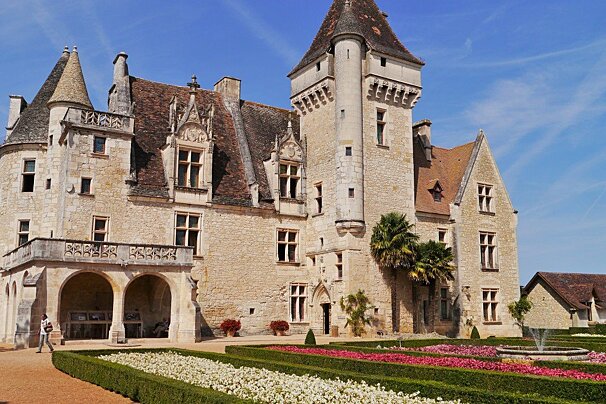
The present castle dates to 1530 when it was built by the Herm family. Its Gothic style consists of a rectangular main building flanked by two round towers.

© Provence Guide
Weekly year-round market on a Sunday morning
Every Sunday morning between 08:00 to 13:00, the town of Sorgues holds a local market.
This friendly local Provençal market is open all year round and offers colourful and fresh local produce including foie gras, walnut oil, cheese and fruit and vegetables.
In December and January this market includes the revered truffle market, selling quality controlled regional truffles.
Centre Ville
The present castle dates to 1530 when it was built by the Herm family. Its Gothic style consists of a rectangular main building flanked by two round towers.
This Renaissance château was built in the 16th century in the village of Villars. Its architecture resembles that of many château in the Loire. It was built for Mondot de La Marthonie who was the first president of the Paris Parliament. Reasonably small in size, it was intended to be a second home where he could go hunting. The interior has been wonderfully restored and it still contains the original wooden timbers.
The caves at Villars were only discovered in 1953 by a team of pot holers from the Périgueux Caving Club who were wandering around the Cluzeau coppice. After many expeditions, over 13 kilometres of galleries and chambers were discovered with some impressive stalactites and stalagmites as well as prehistoric paintings which are thought to date to the Magdalenian period, 17,000 years ago.
This prehistoric cave is situated on a limestone plateau in the Lot valley, in an area speckled with prehistoric remains and megalithic monuments. The cave was discovered in 1965 and is a remarkable subterranean museum. Over 400 metres in length, it preserves human footprints, clay quarries, fireplaces, tools, and many bones. Some of the cave network was used as tombs; nearly 30 skeletons have been discovered dating as far back as the Copper Age. There is also a museum with a good archaeological collection.
This museum is dedicated to Figeac-born Egyptologist Jean-François Champollion who was the first person to interpret Egyptian hieroglyphics from the Rosetta Stone in 1822. As well as charting the course of his short life, this museum depicts the history of script from a number of different languages and has a collection of ancient Egyptian relics.
The beautiful Abbeye de Beaulieu-en-Rouergue was established in 1144 in the valley of the Seye by the Bishop of Rodez. This Cistercian abbey had a successful existence for many years and was expanded in the 17th and 18th centuries. It went into decline as the monastic discipline was relaxed but was saved from ruin in 1960 when it was subject to extensive renovation and turned into a contemporary arts centre which holds a number of temporary exhibitions each year.