Le Petit Train de Perigueux
Discover the art and history of the city of Perigueux, exploring the ancient city, old town and admiring the beauty.

© Chateau Carbonneau

© Chateau Carbonneau
Luxury bed & breakfast and vineyard
Château Carbonneau is situated at the eastern limits of Gironde belonging to both the communes of Pessac sur Dordogne and Gensac. It produces wine under the Sainte Foy Bordeaux appellation which is part of the group Côtes de Bordeaux.
The two hectare park and gardens are the ideal place for a quiet walk and the large swimming pool is a must on hot summer days.
Guests can enjoy breakfast on the south-facing terrace or in the magnificent Napoleon III conservatory. Dinner is served in the dining room or on the terrace on summer nights.
Discover the art and history of the city of Perigueux, exploring the ancient city, old town and admiring the beauty.
Shortly before sunset, or at dawn, following the preparation of the flight you can take off with Lionel, a professional balloonist and paraglider who has been working as a guide in Dordogne for more than 15 years.
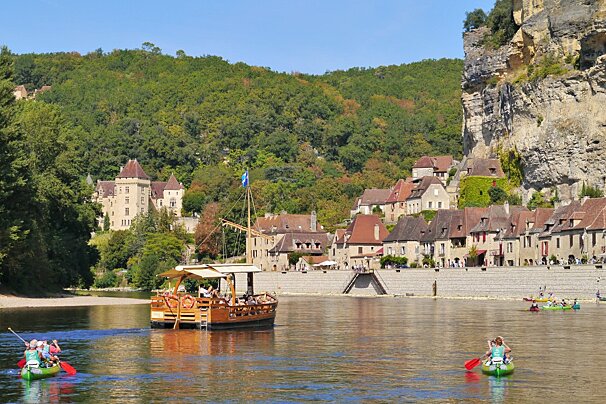
A delightful trip along the river that runs through the heart of Bergerac on a traditional wooden barge.
Brantôme Police Horses provides care and rehabilitation for many horses and ponies alongside donkeys, dogs, cats, sheep, goats and chickens. Situated in the heart of the countryside, just ten minutes north of Brantôme.
A great place for a family day out and to escape the pre-historic world of the Dordogne...instead, enjoy the family atmosphere and displays of this fresh water aquarium.
Also known as the Truffle train, it will take you on a journey of 8 miles (13 Km) round trip, more than 80 meters (260 feet) high cliff, giving a wonderful panorama of the Dordogne Valley.
The dining rooms allow for views of the surrounding vineyards and rolling hills. Drinks can also be enjoyed in the small library or among the chestnut trees.
This elegant and sophisticated two Michelin star restaurant offers creative dishes designed by chef Cédric Béchade, who plays with colours and textures in his cuisine.
In conjunction with the Hôtel Edward 1er, you would expect the restaurant to maintain the high standards and quality that the hotel upholds. That it certainly does, with twists on French classics in a spacious and friendly dining area, set inside an historical stone building, typical of the Monpazier village and surrounding region.
This restaurant offers various possibilities for dining in the same place: a fine restaurant serving modern French cuisine, a bistro with local and seasonal dishes, and a tea room. There is also a beautiful sunny garden overlooking the vineyards.
This restaurant in the old guard rooms of the Château du Viguier Royal, makes this old mansion-house kitchen alive again. The chef, Daniel Authié, creates cooking art which mixes contemporary and traditional flavours. The sommelier and head waiter, Bernard Badia, offers helpful advice on the food characteristics and complementary wines.
The restaurant boasts an innovative menu with a focus on fine local fare and seemless service. The very word Les Merles stands for honesty and delightfulness, which is reflected throughout the dining experience.
The remains have been partly excavated (only about a tenth) and are a magnificent archaeological example.
The home and birth place of Michel de Montaigne (1533-1592), he was one of the most significant philosophers of the French Renaissance, known for popularising the essay as a literary genre.
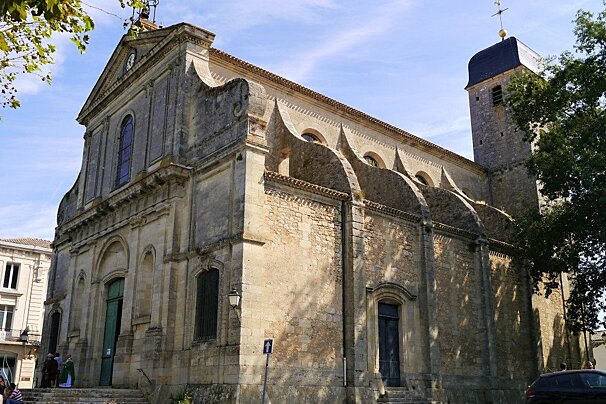
Situated in one corner of the main square in Sainte-Foy-la-Grande, facing the Mairie (town hall), this church has an imposing steeple that reaches high about the streets.
This impressive church was built in 1740 under the patronage of the Marchal of Turenne, count of Castillon, who had left money to the city in his will.
Originally built in the 12th century, this château was transformed in the 14th century into an impregnable fortress with the support of Pope Clement V and his nephew and namesake, Bertrand de Got, then owner of the château. In the 17th century, it was enhanced even further, losing its defensive aspects but gaining stables, formal gardens ad a new reception rooms. Though its interior is a little sparse, you can see the original bakery, some impressive ceremonial rooms and its pretty inner courtyard. It holds festive cultural events throughout the year.
Sited to the west of Saint-Emilion, the impressive square stone keep of this grand King's castle is all that now remains. The views of the city from the tower are well worth the 118 steps.
Sainte-Foy-la-Grande sits on the south bank of the Dordogne river. This attractive walled bastide town still has some of its medieval houses and is a good base for visiting the surrounding Sainte-Foy-Bordeaux wine region and nearby Château de Montaigne, home of Michel de Montaigne.
You get a sense of this town's history as soon as you arrive, with are flags and coats of arms lining the roads that lead you to the main square.
Vineyards were planted around this old town in Roman times and whilst most people associate the name with the wine, the town itself is worth a visit for its ramparted old centre with interesting Romanesque churches and an incredible underground monolithic church.
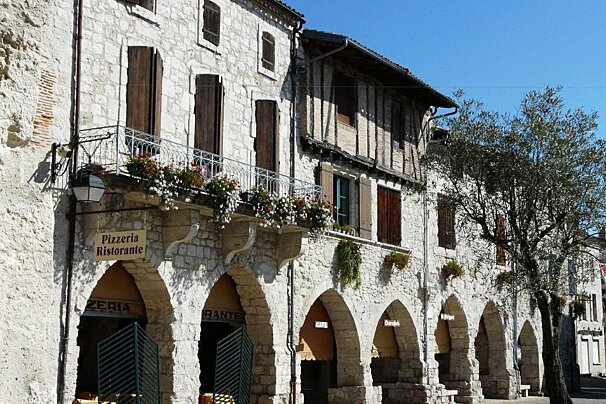
Very much a textbook bastide village, it's laid out in a grid fashion around a central square. Eymet, as it exists today, was founded by Alphonse de Poitiers in 1270.
The largest town in the area, Bergerac, still retains a quaint old feel, with a change in pace in the summer months.
Couze used to be a paper-making village and a number of its old mills are still in existence, using the power of the Couze river to turn the water wheel.