Perigord Adventure & Loisirs Canoe, Beynac-et-Cazenac
Enjoy a relaxing day close to nature as you canoe along the river and explore the waterways of this UNESCO World Biosphere Reserve.

© Les Tuileries de Chanteloup B&B, La Roche-Chalais
Blissful 19th Century guesthouse
The pretty village of La Roche-Chalais; a stones throw from the Dronne river, lays the foundation for your stay in Dordogne. With buildings typical of the region and the hotel at its centre, Laure and Patrice will welcome you into their spacious and inviting guesthouse.
Each large room has a real sense of individuality, with both doubles and triple option available. Your stay will only be enhanced by a daily breakfast, served either in the dining area or out on the terrace. There is also the option for the host to prepare you a dinner, showing off some of the many culinary treats famous in the region (prior reservation required). Alternatively, there is a recommended restaurant just 25 metres from the property.
A large garden, terrace and pool create the perfect excuse to kick back and relax after a long day exploring the area.
Enjoy a relaxing day close to nature as you canoe along the river and explore the waterways of this UNESCO World Biosphere Reserve.
In true French style Le Petit Train will take you on your short journey from the bottom of Rocamadour to the town centre above you.
This area provides water-sports for all ages. Renowned for its architectural heritage and sites of natural beauty, you will find that paddling is a great way to relax and have fun whilst enjoying the scenery.
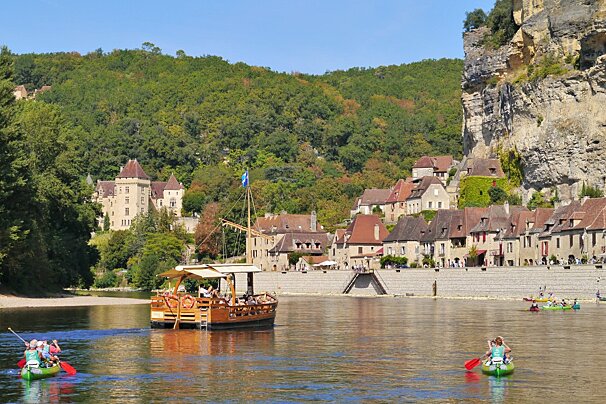
This traditional wooden barge will take you on a picturesque cruise down the river Dordogne from La Roque-Gageac to the Castelnaud bridge.
Aerial adventures including treetop ladders, zip lines, cave routes and rocks faces to climb. This adventure park offers a mix of everything to keep the whole family entertained.
A living museum that offers much more than your ordinary museum or theme park. A great day out that will take you and your family back in time to an era long ago.
The dining rooms allow for views of the surrounding vineyards and rolling hills. Drinks can also be enjoyed in the small library or among the chestnut trees.
This elegant and sophisticated two Michelin star restaurant offers creative dishes designed by chef Cédric Béchade, who plays with colours and textures in his cuisine.
Part of the successful Edward 1er Hotel, the restaurant has a lot to live up to. Welcoming and professional staff greet you into the small 28 seat dining room and you are sure to be delighted by the experience and attention to detail from start to finish.
In the charming little village of Saint Andre de Najac, this charming hotel-restaurant offers fine dining, relaxation and nature.
With a terrace set alongside the Vezerie river and within a hotel clad in Virginia Creeper and decorated with heart, warmth and style, the restaurant is hugely inviting.
Perched on a cliff, the Hôtel l'Esplanade has a great setting with good rooms and more importantly, a fantastic restaurant.
This area was settled by monks in the late 19th century when Napoleon III decided to drain the marshlands in the area. It was established as an abbey in 1876 and the monks began making cheese to make the farm profitable. The community dispersed in the early 20th century but the site was reoccupied by a community of nuns of Espira Agly who were returning from Herrera in Spain. The nuns live under a vow of silence and have restarted the monks' cheese-making business. The abbey itself cannot be visited but they have a good shop selling cheese and confectionary from other missionaries.
The home and birth place of Michel de Montaigne (1533-1592), he was one of the most significant philosophers of the French Renaissance, known for popularising the essay as a literary genre.
Gifted to Gaillard de la Mothe by his uncle Bertrand de Goth, Archbishop of Bordeaux, who later became Pope Clement V, the Cardinal Palace sits at the entrance to the city of Saint Emilion.
The great wall, or Grandes Murailles, is now all that remains of a once Dominican monastery that was built in the 12th-century.
Although the timber facade of this house in Saint Emilion dates from the 16th-century, the foundations were built even earlier than that.
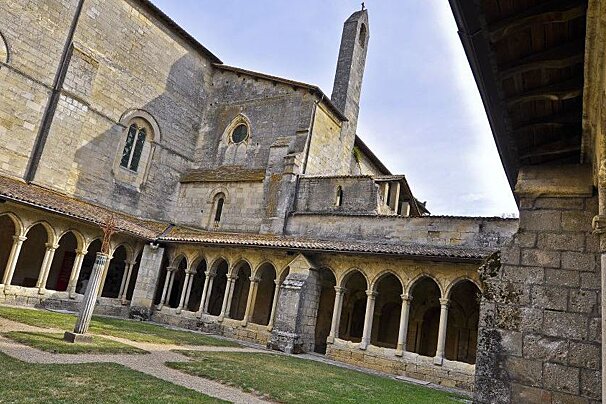
Built between the 12th & 15th centuries, this church is one of the largest in Gironde. It's design is both Romanesque and Gothic, showing how it has been remodelled and renovated throughout history.
Vineyards were planted around this old town in Roman times and whilst most people associate the name with the wine, the town itself is worth a visit for its ramparted old centre with interesting Romanesque churches and an incredible underground monolithic church.
You get a sense of this town's history as soon as you arrive, with are flags and coats of arms lining the roads that lead you to the main square.
Sainte-Foy-la-Grande sits on the south bank of the Dordogne river. This attractive walled bastide town still has some of its medieval houses and is a good base for visiting the surrounding Sainte-Foy-Bordeaux wine region and nearby Château de Montaigne, home of Michel de Montaigne.
The largest town in the area, Bergerac, still retains a quaint old feel, with a change in pace in the summer months.
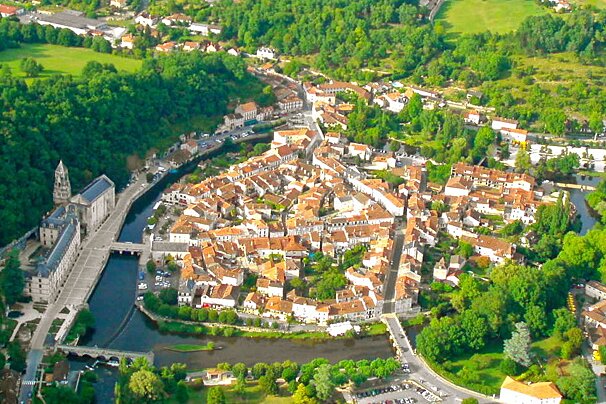
Located on an ancient Roman road, the town of Brantôme on the Dronne river is centred around its 8th century Benedictine abbey.
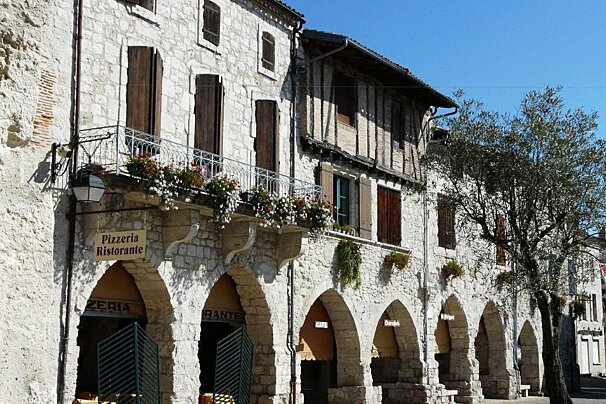
Very much a textbook bastide village, it's laid out in a grid fashion around a central square. Eymet, as it exists today, was founded by Alphonse de Poitiers in 1270.